
Who walks in GodsDog
Every figure in this series is pulled from somewhere real: an icon, a legend, a line in Scripture, a marginal note in a medieval chronicle. These are the ones you meet first. Stranger things live in this world, and they arrive in later volumes.
Spoiler sections stay shut unless you open them.
The Four Rivers
The four leads were not invented one at a time. Matthieu Pageau imagined them as a single pattern of four, the four rivers of Paradise, and tied each to one of the ancient humours. He also designed a simple scheme of expression for showing how the four personalities push against one another.
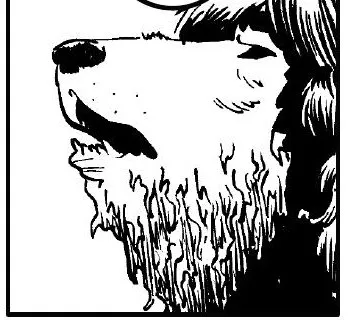 ReprobusMelancholic
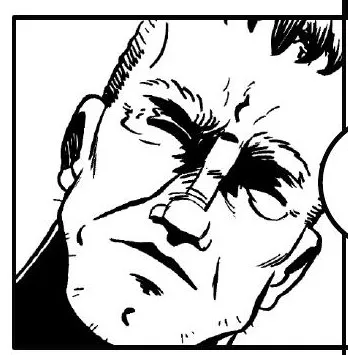 GeorgeCholeric
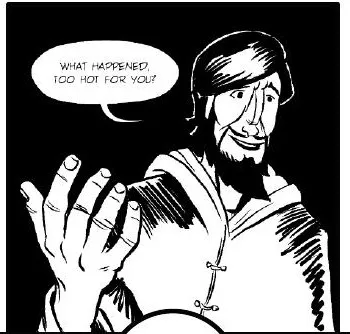 MercuriusSanguine
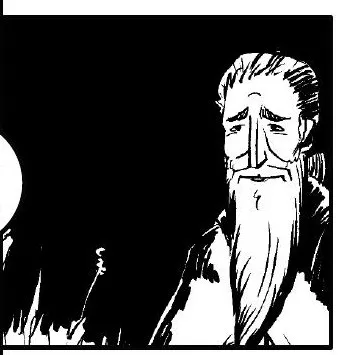 DanielPhlegmatic
of Paradise
Reprobus, later Christopher
The dog-headed man at the centre of the series. Unnaturally large, unnaturally strong, and by every account in the tradition, very ugly.
Reprobus is built from the legends of Saint Christopher, and he is also an amalgamation of every Christian legend involving dog-headed men. That is a deliberate collision. In the East, Christopher is shown as a cynocephalic Roman soldier taken from Lycia. In the West he is mostly a Canaanite giant. GodsDog plays with the ambivalence directly by putting a cynocephalus and a race of giants in the same story and letting them meet.
In the tradition
The most famous legend has Reprobus as a fierce warrior in the land of Canaan who decides to serve the most powerful being in the world. He serves a king until he notices the king fears the Devil, so he leaves to serve the Devil. He notices the Devil fears the Cross, so he leaves to find Christ. A monk offers to show him the way and tells him to pray; Reprobus says he cannot. The monk tells him to fast; Reprobus says he cannot. Finally the monk sends him to a river to carry people across.
One day he carries a child who grows heavier and heavier, until he is certain he will falter mid-stream. He asks the child why. The child answers that he is carrying the sins of the world. That is where the name comes from: Christopher, the Christ-carrier.
Why he matters
In both East and West, Christopher is always a sign of the edge: of transition, of ambiguous spaces. In the West he appears on bridges and became the patron saint of travellers. In the East he was often painted directly over a church door, so that he was the last thing you saw on the way out. The superstition that seeing his image preserves you from death comes from the same intuition, that in Christ, Saint Christopher can help to carry you through difficulties.
Design notes
Jonathan Pageau's earliest concept drawings used a scratchy, detailed approach loosely based on nineteenth-century adventure book illustration. Cord Nielson's default style is simpler and sometimes cartoony. The first phase of development was an attempt to bridge the two: serious and textured enough for an epic, simple enough to stay graphically clear on the page.
Spoiler · his story across volumes one and two
In volume one his origin and backstory are deliberately left vague. What the book gives you is the shape of a longing: Reprobus is searching for something, and he wants to belong. The dog-headed races of the tradition sit behind that gap. In the legends of Alexander the Great the Cynocephali are walled up in the North behind the Caspian Gates with Gog and Magog. In an Ethiopian version of the Acts of Saint Andrew, the apostle meets a cannibal dog-headed man named Abominable who takes the name Christian on his conversion, and whose whole tribe converts with him. Adam of Bremen, writing in the eleventh century, placed the dog-headed men in the Far East and made them both horrible monsters and the guardians of the Garden of Eden.
Volume two puts him under Saint George's training and begins turning the monster into a warrior. Ross Richie of BOOM! Studios, who read it early, would only say: wait until you read what happens to him at the end.
George
The epitome of the soldier saint. Red-haired, martial, and in this story considerably older than the youth of the icons.
Between his name, which means farmer, his red hair and his soldier's rank, George is in many ways an image of Rome itself. The legends make him a youth. GodsDog ages him into a commander so that he can carry the full weight of martial values, and so that his judgment of Reprobus has some authority behind it.
George and the dragon
A pagan city terrorised by a monster had struck an unholy bargain: one virgin a year in exchange for being left alone. One year the lot fell to the king's daughter. She was left outside the walls, George arrived, made the sign of the Cross, and defeated the dragon.
What happens next varies by version, and the variation is the interesting part. Sometimes the dragon is killed. Sometimes it is tamed and led away on a leash made from the virgin's belt. Those two endings are what produced the idea that George can both kill and tame monsters as the situation requires, which is exactly the question he has to answer about Reprobus.
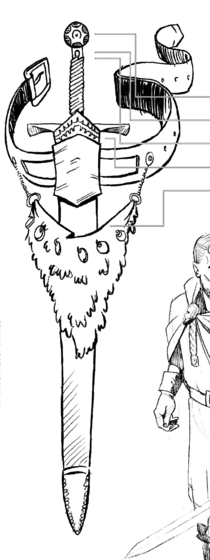
His sword
Cord Nielson designed George's sword and scabbard with cosmic symbolism built into the object: sun and light, tree, serpent, thorns, death. It is a small piece of the whole cosmology carried on one man's hip.
On the scholarship
Scholars often insist the dragon legend is a late medieval invention. Jonathan Pageau treats that as an abuse of scholarship, and points to a sixth-century ceramic tile, the oldest surviving representation of both Christopher and George, which shows the two of them together killing a two-headed snake monster.
Spoiler · George's role in volume two
In Warrior, George takes Reprobus on as a student and trains him as a soldier on the road to the Holy City. The monster-killer teaching the monster to fight is the whole hinge of the volume, and it lands differently once you know the two endings of the dragon legend.
Mercurius
The sly one. Archer, assassin, and the character most likely to have something up his sleeve.
Mercurius is based on a lesser-known warrior saint, a soldier also martyred under Decius and said to be the cousin of Saint George. He does not appear prominently in the first book. His design is the sly-man, the Robin Hood type: pointed beard, expressive eyebrows, hooded cloak, short dagger-type swords.
The dog-headed connection
The most interesting traditions of Saint Mercurius come from Ethiopia, and they run straight into Reprobus. In those traditions Mercurius's father was killed by two cynocephali. Mercurius later encountered the dog-headed men himself and converted them, and from that point on they became his companions and guardians. Ethiopian images of the saint show them standing with him, and Jonathan Pageau has photographed contemporary versions of these images on the outside of churches there.
Coptic icons show Mercurius with two swords, following the Egyptian tradition in which he defended a city with two blades after receiving a flaming sword from the Archangel Michael.
Spoiler · where he is going
The Secrets of GodsDog says plainly that his characteristics will appear more clearly in the upcoming books. Given that the Ethiopian tradition makes him the saint who converts the dog-headed men and keeps them as companions, and the Coptic tradition hands him a flaming sword from Michael, both of those threads are live in a series whose central figure is a cynocephalus and whose cosmology turns on a flaming sword at the gate of Eden.
Daniel
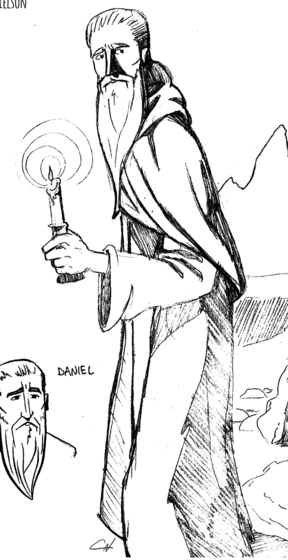
The most loosely adapted of the four. A monk who, at the outset of the story, doubts his faith.
Some of his inspiration comes from Saint Daniel the Stylite, a disciple of Saint Symeon the Stylite. Beyond that he is the character with the most room to move, and the series uses him as the voice that opens it: Daniel is narrating from the monastery when the story begins.
Design notes
He was drawn to seem like a kind man whose kindness also hides some insecurity and sadness. He gives generously of himself but appears to have lost his own confidence. The design also had to let you sense a religious function without stating it, a priest or a deacon maybe, but certainly a monk.
Ancient monks were most probably tonsured. The team chose instead to draw him the way we picture Orthodox monks today, with long hair and a ponytail, because the recognisable image was worth more than the historical one.
Spoiler · the question he is asking
The development pages show him at his desk, writing by candlelight, with the line that frames the whole cosmology of the series: if the skins are lost, what will keep the light from the darkness? What will stop the deep from swallowing the world? That is the garments of skin from Genesis, and it is the question the entire five-volume arc is built to answer.
The Giants and King Nimrod
The residues of ancient civilisations, walking around. Brute strength and arrogant pride bolted onto mixture and confusion.
The giants are based on the Nephilim of Scripture, who later become the Anakim, the Rephaim and others. In GodsDog they are simply Canaanites, descendants of Noah's son Ham as they appear in the Universal History. The name has a useful second edge: Canaanite sits very close in sound to Cainite.
King Nimrod
Their king is named for the son of Cush who built Babel, and he is a pale imitation of him. His city and its tower are a parody and inversion of Babel: a heap of stitched-together residues from other civilisations that looks like it will fall at any moment. Statues of gods stand broken and haphazardly mended with pieces of other statues, producing a cacophony almost impossible to untangle. In his chambers he is making animal hybrids, and the architecture outside is doing the same thing to buildings.
Spoiler · what they are hunting
In Warrior, the lost civilisation of giants stirs because it is hunting the same object the pilgrimage is moving toward: the world's very first relic. What is the power of the ancient relic the giants hunt for, and how will it direct the fates of our heroes?
The Angels
A cherub at the gate, and an archangel with a sword that is also the hinge of the whole cosmology.
The books show the suggestion of a cherub and the image of an angel, Saint Michael, who holds the flaming sword and who ultimately uses it to kill the Leviathan in the grand cosmic story.
Michael is the macro version of George. Both slay dragons. One slays the cosmic dragon, the other embodies that same reality on a human scale, which is why the two designs rhyme and why the series can move between an argument on a road and a war in heaven without changing gears.
Further reading
Matthieu Pageau's essay The Cherub and the Flaming Sword, published in The Secrets of GodsDog, works through the symbolism in full. Jonathan Pageau's three-part essay on the dog-headed Saint Christopher sits beside it in the same volume.